

Shantal Dos Santos y Marianella Pelosi
Universidad Europea de Madrid’s professor, Jorge Sánchez Estrade, during the first day of the Communication and Marketing Week, delivered a masterclass about his experience in the Milano-Cortina 2026 Olympic Games, deepening on the organization of the audio in the development of the event.
He started by clarifying that the OBS is the company which provided the audio for the Olympic Games and it is located in Madrid but also counts with an international team. The talk had the honorable presence through a Zoom meeting of other members of the OBS team including Liang Fu, Anthony Montano, Nuno Duarte and Rowan Smith.
Nuno Duarte, who is the Head of Sound and was streaming from Portugal, mentioned that over 300 people work and there is a whole system that garantises the quality of the audio, including microphones, cables and other equipment.
Rowan Smith, who was live from Australia, in the role of Manager of Audio BTO, explained that this position is about technical strategy and execution, claiming it is not just «mixing sound» but also designing the systems that allow thousands of microphones across different mountain venues to reach billions of listeners globally without a millisecond of failure.
Anthony Montano, live from Canada, is the CDU Audio Supervisor and his role in Milano-Cortina involved the look over technical failures and checking that the audio arrives at the broadcast compound. He also takes a look at transmission schedules and changes that might come up each day, causing drawbacks that he helped to solve. They have constant contact with the people at the stadiums to come up with solutions to any problem.
Liang Fu, who was live from Canada, is the CDU Audio Operator, meaning he is the person physically and technically responsible for the actual sound mix people hear during the broadcast. He was in charge of creating the International Control Feed, which involves balancing the sounds of the crowd, the specific sporting action and the ambient atmosphere; also, ensuring that the sound does not «drop» when the camera angle changes. If the camera zooms in on a skier’s boots, he must ensure the microphones near the boots are prioritized in the mix. He mentions that they would arrive 4 hours prior to the starting of the event in order to check everything was fine in the technical way.
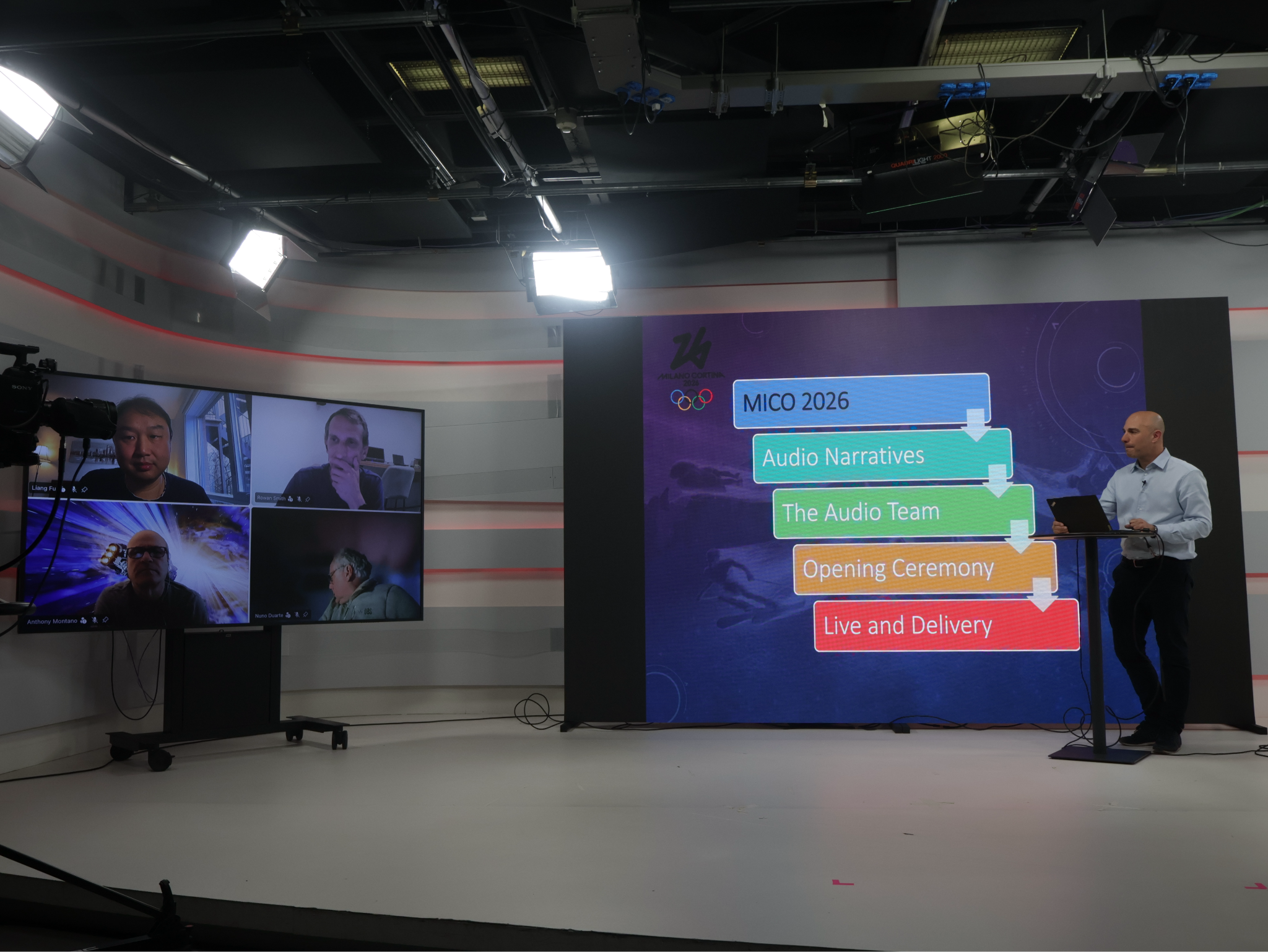
Jorge Sanchez Estrada in Zoom meeting with his teammates at the Universidad Europea communication week. Foto: Marianella Pelosi.
After Milano-Cortina and as preparations for the upcoming Olympic Games intensify, key figures in the audio production departments have shared insights into the immense technical orchestration required to deliver a world-class immersive experience.
Liang Fu, a veteran who began his journey at Beijing 2008, emphasizes the evolution of his role from technical support to high-level production oversight. Moving beyond pure engineering, Fu now focuses on quality assurance. His team conducts rigorous pre-transmission checks to verify signal levels and lip-sync accuracy. Furthermore, he oversees the standardization of signal distribution through the International Broadcast Centre (IBC), ensuring that every feed received and dispatched meets strict global broadcast criteria.
Duarte highlighted the «ripple effect» of troubleshooting. In the high-stakes Olympic environment, the priority is solving technical glitches without creating secondary failures. To achieve this, his team utilizes an extensive suite of real-time monitoring applications. Looking beyond the current event, Nuno noted that their workflow is designed for continuous innovation, often developing solutions that will set the standard for future Olympic cycles.
Montano addressed the delicate balance between massive production scale and emotional intimacy. He argues that for a broadcast to be successful, the audio must perfectly complement the visual narrative; any disconnect results in a loss of impact. During major ceremonies, the audio team operates as a cohesive unit, constantly evaluating microphone placements and equipment shifts. «The goal is to prioritize tasks without compromising quality», Anthony stated, noting that the collective focus remains entirely on the integrity of the transmission.
Smith reiterated that the mission transcends technical perfection, it is about capturing the raw emotion of the athletes and the crowd. According to Smith, every microphone in the Olympic venues has a calculated purpose. The strategic positioning of microphones is the most critical factor in achieving total immersion, ensuring that the global audience feels as though they are physically present at the event.
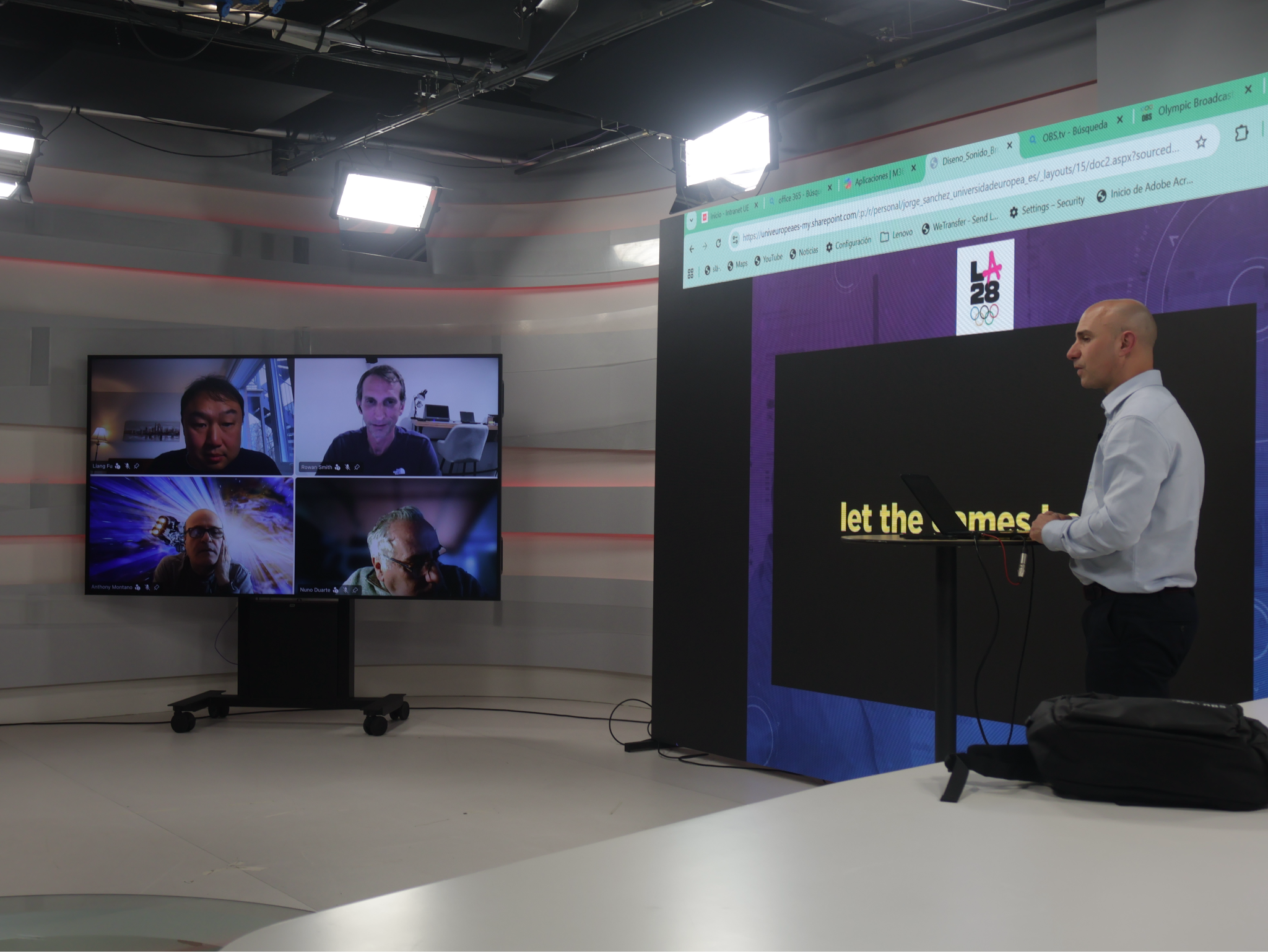
Jorge Sanchez Estrada in Zoom meeting with his teammates at the Universidad Europea communication week. Foto: Marianella Pelosi.
Overall, the talk mixed technical concepts regarding the amount of equipment involved in the broadcasting of such an important event as were the Milano-Cortina Olympic Games 2026. Moreover, all the experts were able to provide their own thoughts regarding their personal experience and focusing on how emotional and tense the event can become. To finish, a promotional video of the next Olympic Games, Los Angeles 2026, was broadcasted.